- JAAF Sustainability Newsletter
- Posts
- JAAF Sustainability Newsletter
JAAF Sustainability Newsletter
November Edition

Ramesh De Silva
November 29, 2025

Dear Reader,
Thank you for being a part of JAAF’s sustainability newsletter. This newsletter is a part of JAAF’s efforts to respond to and serve Sri Lanka Apparel’s evolving needs especially through bridging the knowledge gap that exists in the Environment, Social and Governance Space.
So Welcome! to the November JAAF Sustainability Newsletter, featuring a selection of the latest developments in the sustainability space as it relates to the apparel industry in Sri Lanka. Through this information bridge JAAF aims to curate and communicate the latest developments in sustainability from across the apparel and textile sectors.
We look forward to your ongoing support and encourage you to engage with us by sharing this newsletter with your colleagues and peers in Sri Lanka and afar. You can also subscribe to this newsletter directly by clicking the link below.
Don't hesitate to contact us at [email protected] if you would like to partner or better yet share the developments in sustainability with our community.
Events
Technical Course: Industrial Energy Efficiency Improvement, a live two-day online training designed to help professionals identify and implement cost-effective energy solutions.
December 11–12, 2025 | 1:00–5:00 PM (EST) each day
Platform: MS Teams
Led by Dr. Ethan Languri, Associate Professor of Mechanical Engineering and Director of the Industrial Assessment Center at Tennessee Tech University, this course will equip you with practical tools to:
Evaluate and justify energy projects using Life Cycle Cost Analysis (LCCA)
Understand utility rate structures, power factor, and load shifting
Identify savings opportunities in energy systems
Apply data collection and software tools for real-world energy assessments
This course is ideal for plant managers, energy managers, engineers, maintenance supervisors, sustainability professionals, and financial decision-makers looking to improve efficiency and reduce costs.

Join us on March 30-April 1, Join 500+ manufacturers, suppliers, brands, and industry partners for two days of learning, capability building, and collaboration at the Cascale Forum: Colombo — the region’s leading platform for Higg Index knowledge and advancing practical sustainability solutions across the consumer goods value chain.
JAAF Insights
Improving Transparency for Sustainable Business (ITSB) - The Global Reporting Initiative (GRI), Sustainable Development Council (SDC), Export Development Board (EDB), and Joint Apparel Association Forum (JAAF) held Sri Lanka’s textile and apparel stakeholders to the second ITSB capacity building session.

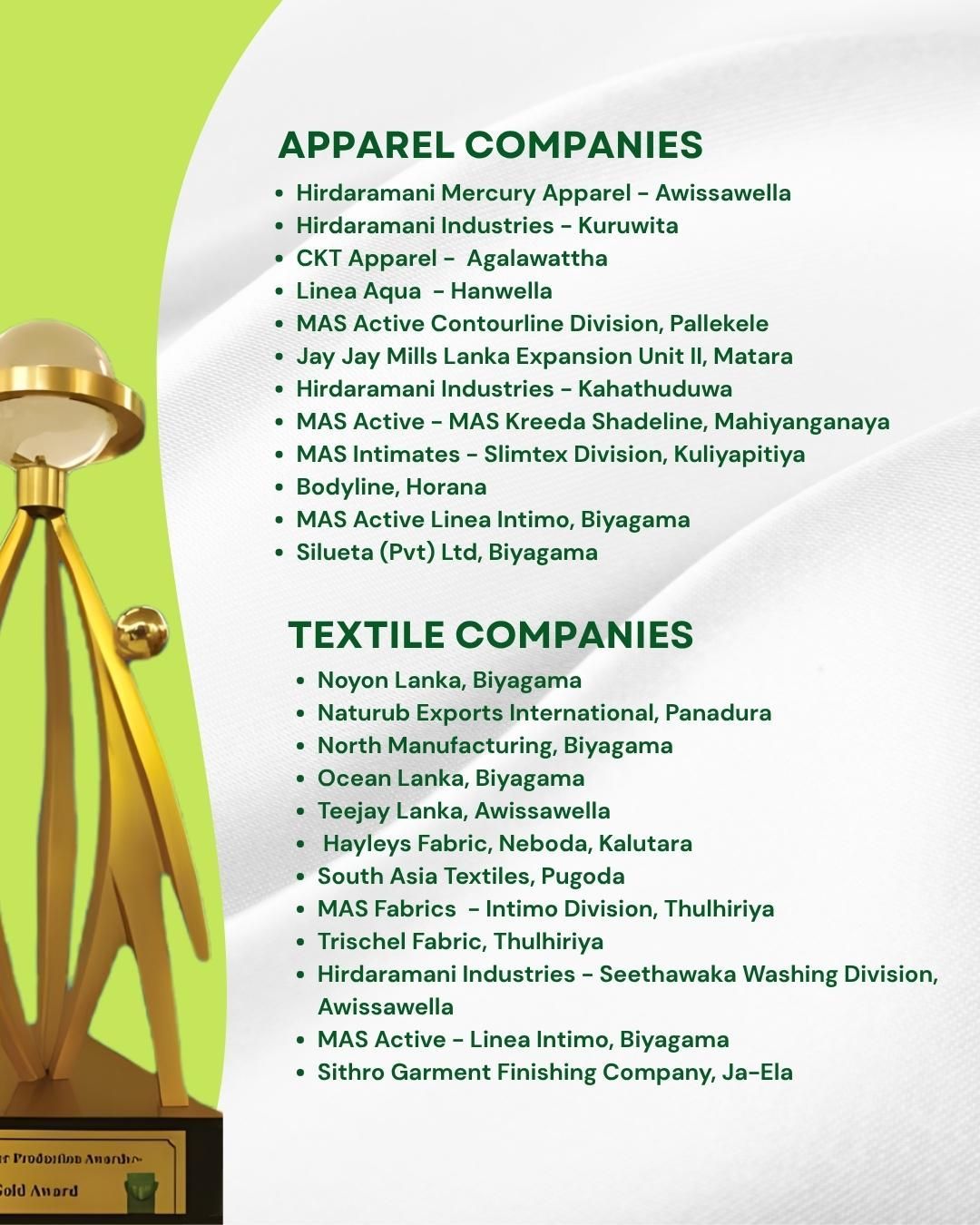
Several textile and apparel companies were recognized at the National Cleaner Production Awards organized by the National Cleaner Production Centre Sri Lanka. The awards celebrate Sri Lankan companies that have shown exceptional commitment to cleaner and more sustainable production.
This is a reflection of the apparel and textile sector’s dedication to advancing sustainable practices in Sri Lanka. Congratulations to all the award recipients!
Sustainability In Sri Lanka

While Sri Lanka maintains the cleanest economic footprint in South Asia in terms of carbon intensity, its greenhouse gas (GHG) emissions grew at a faster rate than its major regional peers in 2024, according to new data released by the European Commission.
MAS sets new goals for sustainable progress - MAS Holdings, South Asia’s largest apparel technology company, has unveiled its Plan for Change 2030, an expanded and more ambitious version of the sustainability roadmap first introduced in 2020
Migration & SDGs Monitoring Platform (MSMP) - this training session was primarily designed for data focal points to familiarize them with the platform’s features and functionalities. The training session included a comprehensive system demonstration and portal overview, guiding participants through dashboard navigation and the use of GCM icons and dashboard features. It also covered the roles and functionalities of administrators and custodians, along with practical guidance on user creation, email registration, and an overview of the MSMP platform’s mobile responsiveness.
Global Fashion Regulations
Circular Economy Strategy now expected in 2026 - The Government’s Circular Economy Strategy for England is now expected to be unveiled in the new year, Defra Secretary of State Emma Reynolds has confirmed.
What COP30 Means for the Future of Fashion - This November, representatives from over 200 countries convened in Belém, Brazil—a city in the heart of the Amazon—for COP30, the most important climate conference in the world.
New ‘science-based’ circularity protocol launched for business at COP30 - The World Business Council for Sustainable Development (WBCSD) and One Planet Network have unveiled a voluntary science-based framework to help companies, manage, measure and improve approaches to circularity across the value chain.
What G20 in South Africa could mean for textile and fashion industries, especially across BRICS nations? - Hosting the G20 in South Africa would not only be a diplomatic milestone but also a strategic opportunity to reshape the textile and fashion industries across developing economies, particularly within BRICS nations
Manufacturers start to phase out production of ‘forever chemicals’ - Leading chemicals companies have quietly begun to phase out production of “forever chemicals” as the risk of litigation grows and the EU looks to impose broad restrictions on their use.
HR compliance perspective on the overhaul of CSRD and CSDDD - On 13 November 2025, the European Parliament adopted its negotiating position on the first Omnibus Package with 382 votes in favour and 249 against.
Apparel Impact Institute’s Energy And Carbon Benchmark - We are pleased to announce the opening of public consultation for the Apparel Impact Institute’s Energy and Carbon Benchmark, an important step toward advancing credible measurement of energy use and GHG emissions across the apparel and footwear sector.
EURATEX urges EU to simplify rules for textiles - The European textile and apparel industry is calling on the European Commission to streamline rather than expand regulations under the forthcoming Circular Economy Act (CEA). In a new position paper submitted this week, EURATEX warns that excessive or fragmented rules could hinder innovation and weaken the competitiveness of Europe’s textile sector.
Cascale Publishes Principles on the Frequency of Environmental Data Reporting - New guidance aims to balance data transparency with practicality and reduce burden on manufacturers
Cascale’s Higg FEM 2025 Update Unlocks New Data-Driven Insights - Refreshed Higg FEM 2025 delivers data-driven insights, sharper emission metrics, and enhanced verification to accelerate industry-wide progress.
With the EU Digital Product Passport approaching, traceability is no longer optional. It is the foundation for regulatory readiness, partner accountability, and accurate sustainability reporting.
White Paper: Building Traceability into the Post-Purchase Lifecycle
Key insights:
Item-level data enables Digital Product Passport and EPR compliance
Structured datasets simplify displacement and emissions reporting
Integrated audit trails reduce the risk of missing or inconsistent records
See how traceable service flows turn compliance obligations into business growth.
Neighborhood Watch
Brazilian Textile Sector Doubles Productivity While Cutting Emissions Significantly -Brazil’s textile sector has achieved remarkable progress in linking economic growth with environmental sustainability, according to recent data from the National Industry Observatory in partnership with the Brazilian Textile and Apparel Industry Association (ABIT).
Future Forward Factory project introduces practical pathways to cut textile emissions by 93% - Fashion for Good launches the first open-source blueprint for near-net-zero textile manufacturing, tackling one of fashion’s biggest emissions hotspots. Developed under the Future Forward Factory project, the blueprint offers Tier 2 manufacturers in India five practical, financially viable pathways to reduce carbon emissions by up to 93%.
India removes quality control orders on polyester - The Confederation of Indian Textile Industry (CITI) has welcomed a decision to rescind 14 Quality Control Orders (QCOs), including seven QCOs covering fibre intermediates and polyester products used across the textile value chain, in a bid to boost exports.
Epic Group drives carbon-free apparel manufacturing with heat pumps in India - Sustainable fashion company Epic Group has advanced carbon-free manufacturing with the installation of high-temperature industrial heat pumps at its apparel manufacturing facility in Bhubaneswar, India.
India steps up textile industry overdrive as Bangladesh, Vietnam remain elephants in the room - The country’s textile industry is upbeat about the government’s rollout of four new labour codes on 21 November, particularly the decision to allow women to work night shifts, saying this would help factories increase RMG production.
Shaping A Circular Future: How The Packaging Industry Is Reinventing Sustainability In India - As conversations around sustainability mature, the packaging industry stands at the forefront of innovation and accountability.
A Year of Circular Progress in Indonesia - Indonesia stands at a pivotal moment in its transition toward more circular and responsible textile systems. As one of the world’s major manufacturing hubs, the country plays a critical role in shaping global material flows, and there is increasing momentum across industry, government, and civil society to align on circular solutions.
Cambodia’s garment sector claims historic agreement - This is a groundbreaking initiative for Cambodia’s garment and footwear sector to support the industry and set a new standard for growth and sustainability.
Vietnam Positions Itself as Emerging Green Transition Hub in Asia - Vietnam used this year’s Autumn Economic Forum to draw a clear line under its ambitions for the next decade: rapid green transition, deep digitalisation and stronger integration into global low-carbon supply chains.
From Recycling to Regeneration: Taiwan’s Vision for the Next Textile Revolution - At TITAS 2025, amid catwalks of recycled blends and showrooms lit by performance fabric demos, Justin Huang, president of the Taiwan Textile Federation (TTF), gave a clear-eyed assessment of where Taiwan’s textile industry must focus to remain both technologically elite and commercially resilient.
General
How Retail is Adapting to Circular Fashion - The global fashion industry is abuzz with the rise of circular fashion—a movement centred on making garments that are biodegradable, recyclable, reusable, and repairable.
M&S Launches RE:Spark To Ignite Renewable Electricity Adoption Across Its Fashion Supply Chain - M&S has today announced the launch of RE:Spark, a new supply chain decarbonization programme developed in partnership with Schneider Electric, a global energy technology leader.
Are Europe's fashion brands as green as they say? - Many European luxury and fast fashion brands have set themselves ambitious sustainability targets. But how many of these have actually been met? DW investigates
Lululemon’s Approach to a Sustainable Materials Supply Chain - Lululemon’s 2024 Impact Report reveals progress and revised goals in sustainability, led by SVP Noel Kinder, with a focus on circularity and materials
How a Circular Economy Helps Cut CO₂ Emissions - Switching to a circular economy can keep materials in use to cut waste and emissions, curb packaging, secure raw materials and help to meet net zero goals
From take-make dispose to circular fashion, machines are changing the game - The fashion world is drowning in its own mess. Every year, we toss out around 92 million tons of textile waste—yeah, that’s a crazy amount—and shockingly, less than 1% of that gets recycled into something new. It’s like we’re stuck in this endless cycle of make, use, and chuck it away.
Fashion CEOs on Mission to Decarbonise Suppliers - A new initiative from The Fashion Pact aims to harmonise supplier data and unlock finance to help the European fashion sector meet its climate goals.
Newsletter Powered By

Reply